
Pyrite in concrete
Pyrite is a sulfurous mineral found in small quantities in limestone or clay stones used for crushed stone fill. In the presence of both water and oxygen, pyrite oxidizes and produces sulfuric acid. The sulfuric acid then reacts with the calcium carbonates contained in the crushed stone as well as with the cementitious products in the concrete.
Sulfatation
This chemical reaction, known as sulfatation, produces gypsum, whose crystallization causes the crushed stone to swell. When the sulfuric acid comes into contact with the underside of the concrete slab, the concrete swells due to sulfatation and begins to deteriorate.
Pyrite-contaminated backfill
The swelling of the backfill beneath concrete slabs causes the slabs to lift, as well as the interior partitions supported by them. This uplift can cause damage to floors, walls, and even the ceilings of the floors located above the partitions.
The thicker the backfill, the greater the swelling. This is why this problem is more common in residential garages, where the backfill often reaches 1 meter in thickness, whereas under basement slabs it generally only ranges from 10 to 20 centimeters.
THE GOUDRONS DU QUÉBEC SOLUTION
How to solve a pyrite problem
For existing constructions, the best solution to the pyrite problem is to replace the crushed stone with certified DB stone and to install a geotextile membrane as well as a vapor barrier between the fill and the concrete slab.
Garage slab level
Basement slab level
Good to know
The presence of polyethylene vapor barriers installed under concrete slabs traps sulfuric acid and virtually eliminates the problem of concrete sulfate attack. Unfortunately, the practice of installing polyethylene under slabs has only become common since the 2000s.
In the absence of a vapor barrier, sulfate attack deteriorates the underside of the slab, and problems often only appear 10 to 20 years after construction. Concrete swelling tends to cause the slab to expand both horizontally and vertically.
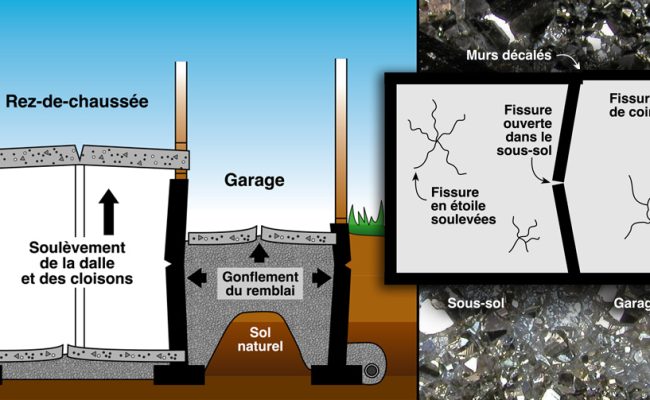
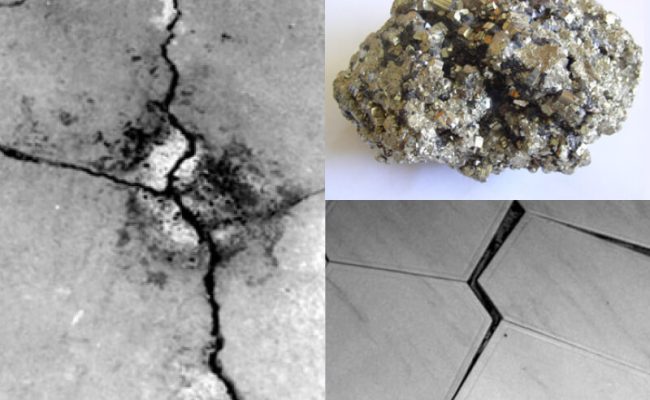
The horizontal expansion of the slab being restrained by the foundation walls, the uplift occurs toward the center of the building, creating a very characteristic void under the slab and forming raised cracks in star or cross shapes.
Geographical location
the main recorded cases
Although the phenomenon can affect all regions of Quebec, some areas are more seriously impacted:
-
The South Shore of Montreal
-
The eastern and western ends of the Island of Montreal
-
Laval and the North Shore
-
The Lower Laurentians
Note: This does not mean that other geographic areas are automatically spared. Numerous isolated cases have been reported throughout the province.
For example, despite the fact that the town of Saint-Lambert is built entirely on bedrock and thus considered by many experts to be a pyrite-free zone, pyrite was still present under the homes in the area. The problem was not related to the nature of the soil, but rather to contaminated backfill from outside quarries.
The thicker the backfill, the greater the swelling. This is why the problem is more prevalent in residential garages, where backfill is often up to 1 m thick, whereas under basement slabs it’s usually only 10 to 20 cm thick.
Concerned about a problem with your foundation?
Our team will offer you the best long-term solution to resolve your pyrite problem. Contact us to receive support from our specialists.
Free quote
Don’t ignore the first symptoms!